
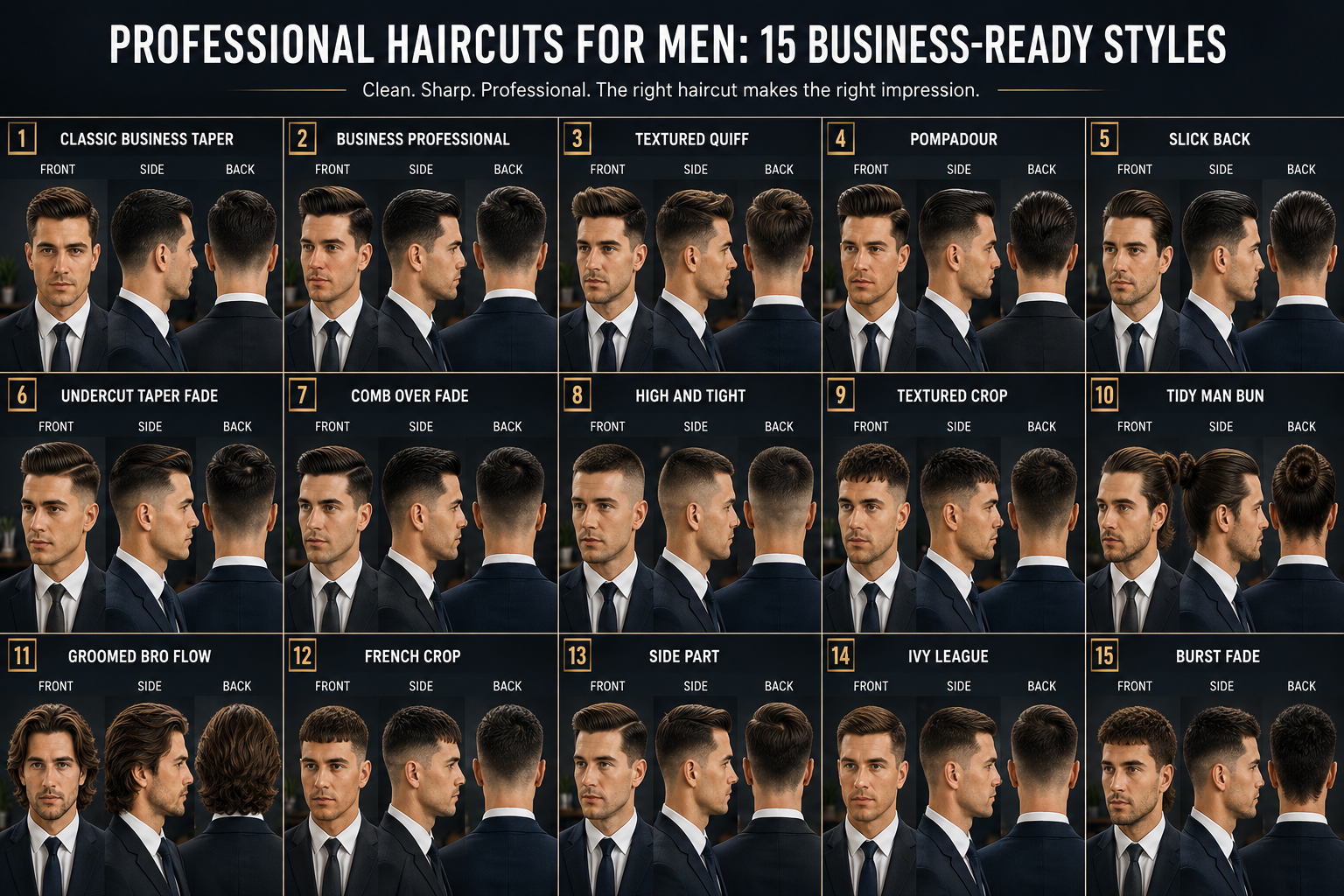
This is the complete men’s haircuts guide for 2026: every haircut type explained from the most basic buzz cut to the most versatile fade, with the terminology you need at the barbershop, face shape guidance for every cut, and maintenance requirements for every style covered. Whether you are walking into a barbershop for the first time or trying to understand the difference between a taper and a fade, this guide covers everything.
Men’s haircuts are defined by their technique, that is, how the hair is cut, rather than just their length. Understanding the technique helps you communicate clearly with your barber and understand why certain cuts suit certain face shapes and hair types better than others.
Men’s Haircut Types: Quick Reference
| Haircut Type | Key Feature | Maintenance Frequency | Best Face Shapes | Hair Type |
|---|---|---|---|---|
| Buzz cut | Uniform short length all over | Every 2 to 3 weeks | Oval, square, diamond | All types |
| Crew cut | Short back and sides, longer on top | Every 3 to 4 weeks | Oval, square, oblong | All types |
| Taper cut | Gradual length reduction at sides/back | Every 3 to 4 weeks | All face shapes | All types |
| Fade | Skin-to-length gradient | Every 2 to 3 weeks | Oval, square, diamond | All types |
| Undercut | Shaved sides, long top | Every 3 to 4 weeks | Oval, square, oblong | Straight, wavy |
| Pompadour | Voluminous swept-back top | Every 3 to 4 weeks | Oval, square, heart | Straight, wavy |
| Quiff | Textured swept-up front | Every 3 to 4 weeks | Oval, square, heart | Straight, wavy |
| Side part | Clean parted top, tapered sides | Every 3 to 4 weeks | All face shapes | Straight, wavy |
| French crop | Short textured fringe, tight sides | Every 3 weeks | Oval, square, diamond | All types |
| Textured crop | Choppy textured top with fade | Every 3 weeks | Oval, square, diamond | Straight, wavy |
Every Men’s Haircut Type Explained
1. Buzz Cut
The buzz cut is the most fundamental men’s haircut: a single guard length applied uniformly across the entire head using clippers. No blending, no fading, no styling, just one consistent length from front to back and ear to ear. The number of the guard used determines the length: a number one buzz is roughly one-eighth of an inch; a number four is half an inch. The buzz cut suits oval, square, and diamond face shapes best. It requires no styling products and minimal at-home maintenance. Fresh buzz cuts are needed every two to three weeks to maintain their intended length. For detailed variations and style options, see our complete haircuts guide.
2. Crew Cut
The crew cut keeps the top of the head slightly longer than the sides and back, typically one to two inches on top, tapering down at the sides without a sharp fade line. The result is a clean, masculine cut that suits almost any face shape and professional context. The crew cut is considered the most universally appropriate men’s haircut: appropriate in every professional environment, easy to maintain, and requiring minimal daily styling. It was the standard military cut of the twentieth century and remains one of the most popular men’s haircuts worldwide. Fresh cuts every three to four weeks keep it looking sharp.
3. Taper Cut
A taper cut uses clipper blending to gradually reduce the hair length from longer at the top to shorter at the sides and back, but it stops before reaching the skin. The key distinction between a taper and a fade is that the taper transitions to very short hair above the ear and at the neckline, while the fade transitions to skin. Tapers are more conservative and suitable for all face shapes and professional environments. The taper can be applied to virtually any top style, including pompadour, side part, quiff, or natural, making it the most versatile cutting technique available. See our guide to professional haircuts for men for taper-based work styles.
4. Skin Fade
The skin fade (also called a bald fade) blends from the natural hair length down to bare skin somewhere on the sides or back. Where the fade starts (high, mid, or low) determines the name and the visual effect. A high skin fade starts immediately above the ear and at the occipital bone, creating maximum contrast. A mid fade starts at the temple. A low fade starts just above the ear. All skin fades require a skilled barber every two to three weeks to maintain the clean gradient. The fade grows out faster and more visibly than any other cut type. The skin fade pairs with any top style.
5. High Fade
The high fade is a specific fade position: the transition from full-length hair to skin begins at or above the temples, leaving only the very top section of the head with significant length. The high fade creates the highest contrast of any fade type. The top section is visually isolated from the sides, creating a dramatic, modern aesthetic. It suits oval, square, and diamond face shapes. High fades look best on men with dense, defined top sections, as the contrast draws attention upward and benefits from the top having visual interest. See our men’s hairstyles guide for top styles that pair with high fades.
6. Low Fade
The low fade transitions from full length to skin just above the ear, the lowest possible starting point for a fade. The low fade creates the least contrast of any fade type and is therefore the most conservative fade option. It suits all face shapes and all professional environments outside the most restrictive contexts. The low fade blends naturally into the surrounding hair, making it appropriate for men who want the clean look of a fade without the high-contrast, modern aesthetic. It is the professional’s fade, the choice for corporate and business-formal environments where a full skin fade might read as too trendy.
7. Mid Fade
The mid fade is the most popular fade position. The transition to skin begins at the mid-temple, creating a balanced contrast between the low fade’s conservatism and the high fade’s drama. The mid fade suits all face shapes and most professional environments. It is the default fade that most barbers apply when a client requests “a fade” without specifying. The mid fade pairs with virtually every top style: textured crop, pompadour, quiff, natural afro, braids, and more. For most men, the mid fade is the best starting point for exploring fade-based haircuts.
8. Undercut
The undercut shaves or clips the sides and back of the head to a uniform very short length while keeping the top significantly longer, creating a sharp disconnected line between the two sections rather than a gradual blend. The undercut emphasises the contrast between the long top and the cropped sides without a fade transition. It is a bolder, more contemporary version of the taper concept. The disconnected undercut is even sharper, with a visible line between the clipper section and the top. The undercut suits oval and square face shapes best. Styling products are essential to manage the longer top section. See our hairstyles guide for undercut top style options.
9. Pompadour
The pompadour sweeps the top hair back and upward from the forehead, creating a voluminous vertical section at the front that is the focal point of the cut. The classic pompadour uses maximum volume; modern variations include the low pompadour (smaller, more relaxed volume), the fade pompadour (skin fade sides with pompadour top), and the textured pompadour (choppy texture instead of smooth sweep). The pompadour requires medium-to-strong hold products and daily styling investment. It suits oval, square, and heart face shapes. The vertical volume at the front creates the illusion of length in shorter or rounder faces. See our professional hairstyles guide for pompadour work styling.
10. Quiff
The quiff is a close relative of the pompadour. The front section is lifted and swept back, but typically with more texture and less volume than a classic pompadour, and with a natural rather than slick finish. The quiff is the most popular modern dressed style for men because it bridges the gap between formal and casual: it looks intentional without looking overly done. It suits oval, square, oblong, and heart face shapes. Medium-hold, matte or low-sheen products work best. The modern textured quiff, with choppy, piece-y texture instead of a smooth combed finish, is the dominant interpretation in 2026.
11. Side Part
The side part creates a defined parting line through the top of the hair, typically at the natural part or slightly more pronounced, with the hair combed cleanly to either side. The classic side part is polished and professional. Modern interpretations include the deep side part (a more dramatic, further-from-centre part line) and the hard part (a razor-cut line instead of a combed part). The side part suits all face shapes and all professional environments. It is the most broadly applicable dressed haircut for men. Products range from light-hold creams for natural finishes to firm pomades for classic slick looks. See our guide to professional men’s haircuts for side part styling by workplace.
12. French Crop
The French crop features a short, horizontal fringe across the forehead, cut straight and sitting just above the eyebrows, with tight, close-cut sides and back. The result is a clean, structured look with strong horizontal lines. The fringe can be textured (choppy, natural) or blunt (clean-cut straight edge). The French crop suits oval, square, and diamond face shapes. The horizontal fringe works particularly well for men with high foreheads, as it reduces visual forehead length. This is a low-maintenance styled cut. The fringe sits naturally without daily styling effort. Fresh cuts every three weeks maintain the fringe line. See our hairstyles guide for French crop variations.
13. Textured Crop
The textured crop is the defining men’s haircut of the 2020s: a short, choppy top with either a skin fade or tight taper on the sides and back, styled with matte products for a natural, piece-y texture. Unlike the French crop’s horizontal fringe, the textured crop uses a more natural, varied top section that falls forward with texture rather than sitting in a clean line. The textured crop suits all face shapes and hair types including wavy and lightly curly hair, which benefits from the texture work. It requires minimal daily styling. A small amount of matte clay or paste applied to slightly damp hair is enough. This is the most popular men’s haircut in the UK, Australia, and much of Europe.
14. Ivy League Cut
The Ivy League is a longer version of the crew cut. The top is kept long enough to part and comb, typically two to three inches, while the sides are tapered short. The result sits between the crew cut and the full side part in terms of length and formality. It is named for the American Ivy League universities where it was popular in the 1950s. The Ivy League is the most formally appropriate longer men’s haircut. It suits all conservative professional environments while giving enough length for styling variety. All face shapes carry it. See our professional haircuts guide for Ivy League styling detail.
15. Caesar Cut
The Caesar cut features a horizontally cut fringe of one to two inches that falls forward onto the forehead, with the rest of the top kept at the same uniform short length. The sides are tapered or faded. The Caesar is named for Julius Caesar, whose coin portraits show a similar frontal fringe. It is a low-maintenance, low-styling option that suits men who want a defined look without daily effort. The horizontal fringe suits oval and square face shapes best. For men with thinning hair, the Caesar cut’s forward-falling short fringe covers the front hairline effectively.
16. Slick Back
The slick back keeps the top long, typically three to five inches, and combs it straight back from the forehead with no parting line, using high-hold, high-shine products for the classic version. The modern slick back uses lower-hold products for a less lacquered finish. The slick back requires medium to long top length and straight or slightly wavy hair. It suits oval, oblong, and square face shapes. The slicked-back undercut and slicked-back fade are common modern pairings, combining the slick top style with modern fade sides. High-shine pomade or water-based gel are the classic product choices. See our men’s hairstyles guide for product recommendations by finish level.
17. Man Bun
The man bun requires the longest growth period of any mainstream men’s style, typically eight to twelve inches of length to achieve a full bun without stray sections. The hair is gathered at the back of the crown and secured with an elastic. The undercut man bun combines shaved or closely clipped sides with a long top section gathered into a bun. This is the most popular man bun variation. The full man bun keeps the sides at medium length alongside the long top. The low man bun sits lower on the head, closer to the nape. Oval and oblong face shapes carry the man bun best. Regular moisturising and minimal heat styling keep long hair healthy through the growth process.
18. Natural and Afro Styles
Natural and afro styles embrace the hair’s natural curl pattern rather than straightening or heavily processing it. The classic afro allows natural curl growth outward in all directions and shapes it into an even, rounded form. Modern natural styles include the tapered afro (natural on top, fade or taper on sides), the coil-and-defined natural (product-enhanced defined curls), and the twist-out or braid-out (natural curl enhanced by protective styling). Natural styles suit oval, diamond, and heart face shapes best. The volume creates width that balances narrow or angular features. For styling and maintenance of natural hair, see our men’s hairstyles guide.
19. Mohawk
The mohawk shaves or closely clips the sides of the head and leaves a strip of hair running from the forehead to the nape along the centre of the head. The classic punk mohawk uses maximum contrast and height. The modern faux hawk softens this: the sides are faded rather than shaved, and the centre strip is styled upward with product rather than standing rigidly. The faux hawk is the more practical and workplace-appropriate version that retains the visual statement of the classic mohawk. Oval and long face shapes carry the central height strip best. See our warrior cut guide for mohawk history and variations.
20. Shaved Head
The shaved head, whether zero guard or razor-shaved to bare skin all over, is the most low-maintenance men’s hair option, eliminating styling products and barbershop visits almost entirely. Men with thinning hair or receding hairlines often find the shaved head the most confident and commanding presentation compared to any length of thinning hair. The shaved head suits oval, square, and diamond face shapes most naturally. Regular moisturising of the scalp prevents dryness and flaking. Sun protection for the exposed scalp is essential in warmer weather. The shaved head with a full beard is one of the most popular masculine style combinations. See our beard styles guide for beard options that complement the shaved head.
Men’s Haircut Face Shape Guide
| Face Shape | Best Haircut Types | What to Look For |
|---|---|---|
| Oval | Any haircut type | Most versatile: almost nothing is wrong |
| Square | Textured crop, quiff, pompadour, side part | Softens strong jaw with texture or volume |
| Round | High fade, quiff, pompadour, faux hawk | Adds height to elongate the face |
| Rectangle/Oblong | Crew cut, French crop, side part, Caesar | Avoid height; horizontal cuts balance length |
| Diamond | Textured crop, natural, mid fade, side part | Adds width at forehead or crown |
| Heart | Side part, quiff, textured crop, mid fade | Avoid very close sides; keep some width at jaw |
Barbershop Terminology: What to Say
| Term | What It Means | When to Use |
|---|---|---|
| Fade | Gradual blend from length to skin | When you want skin visible at sides/back |
| Taper | Gradual length reduction without reaching skin | Conservative cuts, professional environments |
| Neckline (blocked) | Straight horizontal line at nape | When you want a clean, square neckline |
| Neckline (tapered) | Blended, natural-looking neckline | When you want a softer, more natural finish |
| Texture | Choppy, piece-y finish, not smooth | Textured crop, modern quiff, natural styles |
| Guard number | Clipper guide length (1 = 1/8 inch, 4 = 1/2 inch) | Specifying exact clipper length |
| Scissor over comb | Blending with scissors rather than clipper | Softer, more natural-looking blends |
Frequently Asked Questions
What is the difference between a taper and a fade?
A taper transitions from longer hair at the top to very short hair at the sides and neckline but stops before reaching bare skin. A fade continues all the way down to skin somewhere on the sides or back. The taper is more conservative and natural-looking; the fade creates higher contrast and a more contemporary aesthetic. Both are created using clippers, but the fade requires more precision and skill to execute cleanly. For professional environments, the taper is usually the safer choice; for modern barbershop styles, the fade is the more common default.
How often should men get a haircut?
Short, faded cuts (skin fade, buzz cut, high and tight) need a fresh cut every two to three weeks to maintain their intended appearance. Medium-length cuts (crew cut, taper, side part, textured crop) look best with a fresh cut every three to four weeks. Longer styles (pompadour, man bun, slick back, natural afro) can go four to six weeks between cuts. These are general guidelines. Individual growth rates vary. The right signal is when the cut starts to lose its shape and intended proportions, not a fixed calendar schedule.
What men’s haircut suits thinning hair?
For thinning hair, shorter cuts are almost always better. The buzz cut, Caesar cut, shaved head, and textured crop all handle thinning hair well because they eliminate the length contrast between thinning areas and denser areas. The crew cut and French crop also work well. Avoid long tops with hard partings, slicked-back styles, or anything that requires the hair to cover distance. These make thinning most visible. For more detail on cuts specifically optimised for thinning hair, see our thinning hair haircuts guide.
What is the most popular men’s haircut?
The textured crop with mid skin fade is the most popular men’s haircut in the UK, Australia, and much of western Europe as of 2026. In the United States, the mid fade with a textured or natural top is the dominant style in barbershops. The crew cut and side part remain the most popular professional haircuts globally. The faded buzz cut is the most popular military and sports-adjacent cut. Popularity varies significantly by geography, age group, and workplace context. The most popular cut for your specific context is always better than the globally most popular cut if it does not suit your face, hair type, or lifestyle.
For detailed guides on specific haircut categories, see our complete resources: professional haircuts for men, professional hairstyles, haircuts for thinning hair, haircuts for men over 50, and our full men’s hairstyles guide.